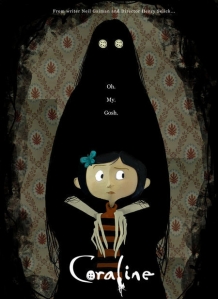
 My son Ray has been making movies since he was six: stop motion animation, live action, and lately, CGI parodies of Star Wars. He reads film production books and bios of animators like Chuck Jones, and loves ‘making-of’ bonus features and little biopics about revered figures like Ray Harryhausen. One of his ‘mentors’ is Henry Selick, who has just completed his adaptation (for 3D stop-motion animation) of Neil Gaiman’s novel, Coraline.
It was our enormous good fortune—mine, my son’s, my daughter’s, my husband’s, and his mother’s—to visit the set of Coraline a couple of years ago, and a real treat to see a preview screening of the finished work the other night in Manhattan, with Henry Selick on hand to answer audience questions.
My son wasn't sure he wanted to see a "horror" movie.
So we headed into NYC with the plan that he would shut his eyes, pull his jacket up over his face, and hold his hands to his ears if it all got to be too much. He was willing to endure, if only for the Q&A portion of the evening.
As it turns out, he didn’t have to worry too much. He only shut his eyes once, and not for long. While the idea of Coraline is truly terrifying—a girl is left alone to rescue her supernaturally abducted parents—its creators have allowed the idea to carry most of the weight of emotion, as with the best fairy tales, and haven’t piled onto it with 3D shock effects or long, anxiety-provoking suspense sequences. The Nightmare Before Christmas, with its cast of characters in varying states of decomposition, is more horrific—at least to me, and I think my son, who got to an age where he felt too uneasy to watch it, and wouldn’t go near the undead-dominated Corpse Bride, would agree.
Henry Selick has done a beautiful job of reconceptualizing the novel for the screen and for stop motion. From the first moments, when metal hands sew up a doll-sized version of the title character and cast her into a void, it feels like this is a movie partly about the animator and the animator’s art. These are the hands of the evil Other Mother, creator and destroyer of the Other World, but here they are, bare of fleshly trappings, primordial armature. We come to find that the energy of children is what makes the Other Mother’s material other world, and it is their life force that makes it beautiful, whimsical, and inviting.
If you have watched any of the featurettes about Coraline, you have seen artist after artist toiling and tinkering away, as artists always do on these projects, though now, with the Internet, in less obscurity. They can even blog about their work for Laika Studios. It’s hard to watch that image of armature hands making the Coraline doll and not think of all the human hands that have gone into the making of this supremely hand-made movie, and seeing in these moments a tribute to them all (certainly they deserve a tribute, including those several dozen Laika workers, I was sorry to read, who were recently laid off).
OtherMotherWorld is especially fanciful and so packed with detail it's hard to imagine not seeing the movie many times to try to take it all in. Henry S. has ensured that the Other Mother’s overture to Coraline is suitably seductive. She—and we—are truly tempted to stay and sample more delights from the animators’ cabinet of wonders. (And the wonders really are wonderful; we laughed throughout the early other world scenes.)
Henry Selick’s Other Mother is a kind of ‘50s fantasy mom—she cooks brilliantly in heels, perfect make-up, and manicure and wears a stainless, starched apron. Other Father is affable, doting, and fun (aside from the saucy, riotous French and Saunders as the Misses Spink and Forcible, my favorite vocal performance is John Hodgman's as the Fathers Real and Other).
Coraline's real world parents, by contrast, are familiar to us as contemporary, overworked telecommuters (fortunate in that sense, they write at home on gardening) who share the work of their life equally, don’t exactly excel in the kitchen, and don’t have much time for their daughter.
That Coraline's creativity will rival the Other Mother's is intimated by a lovely scene that is not in Neil Gaiman’s book. Having returned from an early foray into the other world, Coraline finds her apartment empty; her parents have not come home from work and grocery shopping. Newly arrived in a strange place, friendless and now abandoned by her parents, she goes to bed alone, making pillow-people versions of her mom and dad to comfort herself—the Other Mother isn't the only one who can conjure power from a doll. I think Coraline's realization that they're not coming back is the scariest moment in the story (though Gaiman's protagonist is pretty brave at this point, as I recall). Henry S. wisely lingers long enough for us to feel her loneliness and her sadness.
A resourceful adventurer who is, like too few movie protagonists—even at the dawn of the 21st century—a girl, Coraline would be perfect if not for Henry S.’s addition of a boy to come to her aid in her time of need. Or so I thought when I heard about him. But Wybie (nicknamed "Why Be Born" by Coraline—I guess Henry S. knew some of us would resist), who gives Coraline someone other than a (really cool) cat to dialog with, adds a melancholy element to the other world, where he is more expressive for his muteness.
When my son and I came back up the Hudson River the day after the screening, and made our report to his sister, she said, “I think I’ve changed my mind. I do want to see Coraline.” I look forward to seeing it again with her.
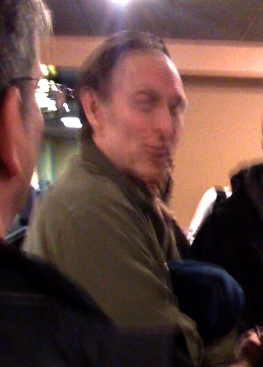 We were too shy to ask for a shot of Henry S. with Ray, but here he is after the Q&A. Be sure to view through your 3D glasses.
I'll be blogging more thoughts on Coraline on my other blog, Oswegatchie. Look for the Coraline tag.
 1982, Dir. Jim Henson, Frank Oz