Showing posts with label animation. Show all posts

Saturday, May 23, 2009

The Curious Adventures of Mr. Wonderbird


Available (and preferable) in French as Le Roi et l'Oiseau
Directed by Paul Grimault
Produced by André Sarrut
Color, animation, 63 minutes
Based on "The Sheperdess and the Chimney Sweep," by Hans Christian Andersen, adapted by Grimault and Jacques Prévert
Recommended for 8 and up

Astonishing for its inventiveness and surrealism, this odd and striking story may not be embraced by every child but is sure to give moments of delight. It goes by several titles and is available in both French and English; in this version, the title character, a despot-defying bird (who happens to be a doting single dad), is voiced hilariously by Peter Ustinov. A tyrant king, living in a castle high above his subjects, is in love with the portrait of a shepherdess, who comes to life from a painting. She and her true love, a chimney sweep, escape into a deserted city (picture Venice painted by de Chirico), and are then trapped in an underground kingdom where the king's subjects live without birds or sunlight. Full of surprises, amusements, and stunning animation. Apparently some have picked this gem up for a buck at WalMart, but greatly preferable: order the director's version, LE ROI ET L'OISEAU from Amazon.fr. The story easily survives a lack of subtitling, and kids deserve to see this level of cinematic art in the version intended by the creators. A few caveats: the king, who is both an object of fun and creepy, shoots bird for sport (though we don't see him kill one) and destroys his city with a giant waldo; there are moments of peril for major characters and the king dispenses with minor ones by pushing a button so they disappear through the floor or by having them flung aside by his robotic henchman. This is available in the English version on VHS from Facets for mail rental.

Thursday, January 15, 2009

Preview + Review of Long-Awaited CORALINE

CORALINE is scheduled for release to theaters on February 6, 2009.

My son Ray has been making movies since he was six: stop motion animation, live action, and lately, CGI parodies of Star Wars. He reads film production books and bios of animators like Chuck Jones, and loves ‘making-of’ bonus features and little biopics about revered figures like Ray Harryhausen. One of his ‘mentors’ is Henry Selick, who has just completed his adaptation (for 3D stop-motion animation) of Neil Gaiman’s novel, Coraline.

It was our enormous good fortune—mine, my son’s, my daughter’s, my husband’s, and his mother’s—to visit the set of Coraline a couple of years ago, and a real treat to see a preview screening of the finished work the other night in Manhattan, with Henry Selick on hand to answer audience questions.

My son wasn't sure he wanted to see a "horror" movie. 
So we headed into NYC with the plan that he would shut his eyes, pull his jacket up over his face, and hold his hands to his ears if it all got to be too much. He was willing to endure, if only for the Q&A portion of the evening.

As it turns out, he didn’t have to worry too much. He only shut his eyes once, and not for long. While the idea of Coraline is truly terrifying—a girl is left alone to rescue her supernaturally abducted parents—its creators have allowed the idea to carry most of the weight of emotion, as with the best fairy tales, and haven’t piled onto it with 3D shock effects or long, anxiety-provoking suspense sequences. The Nightmare Before Christmas, with its cast of characters in varying states of decomposition, is more horrific—at least to me, and I think my son, who got to an age where he felt too uneasy to watch it, and wouldn’t go near the undead-dominated Corpse Bride, would agree.

Henry Selick has done a beautiful job of reconceptualizing the novel for the screen and for stop motion. From the first moments, when metal hands sew up a doll-sized version of the title character and cast her into a void, it feels like this is a movie partly about the animator and the animator’s art. These are the hands of the evil Other Mother, creator and destroyer of the Other World, but here they are, bare of fleshly trappings, primordial armature. We come to find that the energy of children is what makes the Other Mother’s material other world, and it is their life force that makes it beautiful, whimsical, and inviting.

If you have watched any of the featurettes about Coraline, you have seen artist after artist toiling and tinkering away, as artists always do on these projects, though now, with the Internet, in less obscurity. They can even blog about their work for Laika Studios. It’s hard to watch that image of armature hands making the Coraline doll and not think of all the human hands that have gone into the making of this supremely hand-made movie, and seeing in these moments a tribute to them all (certainly they deserve a tribute, including those several dozen Laika workers, I was sorry to read, who were recently laid off).

OtherMotherWorld is especially fanciful and so packed with detail it's hard to imagine not seeing the movie many times to try to take it all in. Henry S. has ensured that the Other Mother’s overture to Coraline is suitably seductive. She—and we—are truly tempted to stay and sample more delights from the animators’ cabinet of wonders. (And the wonders really are wonderful; we laughed throughout the early other world scenes.)

Henry Selick’s Other Mother is a kind of ‘50s fantasy mom—she cooks brilliantly in heels, perfect make-up, and manicure and wears a stainless, starched apron. Other Father is affable, doting, and fun (aside from the saucy, riotous French and Saunders as the Misses Spink and Forcible, my favorite vocal performance is John Hodgman's as the Fathers Real and Other).

Coraline's real world parents, by contrast, are familiar to us as contemporary, overworked telecommuters (fortunate in that sense, they write at home on gardening) who share the work of their life equally, don’t exactly excel in the kitchen, and don’t have much time for their daughter.

That Coraline's creativity will rival the Other Mother's is intimated by a lovely scene that is not in Neil Gaiman’s book. Having returned from an early foray into the other world, Coraline finds her apartment empty; her parents have not come home from work and grocery shopping. Newly arrived in a strange place, friendless and now abandoned by her parents, she goes to bed alone, making pillow-people versions of her mom and dad to comfort herself—the Other Mother isn't the only one who can conjure power from a doll. I think Coraline's realization that they're not coming back is the scariest moment in the story (though Gaiman's protagonist is pretty brave at this point, as I recall). Henry S. wisely lingers long enough for us to feel her loneliness and her sadness.

A resourceful adventurer who is, like too few movie protagonists—even at the dawn of the 21st century—a girl, Coraline would be perfect if not for Henry S.’s addition of a boy to come to her aid in her time of need. Or so I thought when I heard about him. But Wybie (nicknamed "Why Be Born" by Coraline—I guess Henry S. knew some of us would resist), who gives Coraline someone other than a (really cool) cat to dialog with, adds a melancholy element to the other world, where he is more expressive for his muteness.

When my son and I came back up the Hudson River the day after the screening, and made our report to his sister, she said, “I think I’ve changed my mind. I do want to see Coraline.” I look forward to seeing it again with her.

We were too shy to ask for a shot of Henry S. with Ray, but here he is after the Q&A. Be sure to view through your 3D glasses.

I'll be blogging more thoughts on Coraline on my other blog, Oswegatchie. Look for the Coraline tag.

Wednesday, April 18, 2007

Women. We'll Settle for Half.

That's the official t-shirt of an organization called See Jane, founded by Geena Davis to correct the remarkable continuing disparity between male and female characters in programming aimed at young people. Incredibly, the entertainment industry needs more studies and data to convince it that girls, and female smurf-like characters and animals and so forth, are still largely missing from the sewage system that is mass media. Such activities keep the Annenberg School in business, I suppose, but sheesh, we all know TV and movies are male-dominated stories told from male perspectives with a pink bow slapped on here and there, and rather frequently a dead mother, to make us shed a tear. What a crushing bore! If it weren't for the exceptions, many of them celebrated right here at Alternative Films for Kids, we'd give up. But the exceptions shine so gloriously that we, like the good people at See Jane, prefer to keep pushing for improvement. Davis spoke about See Jane recently at the National Conference for Media Reform. (After watching Geena, have a look at the amazing keynote by Bill Moyers).

More good news for girls: Henry Selick is now in production with an animated screen adaptation of Neil Gaiman's Coraline. This is a story about a girl. That's it! No boy sidekick, no brother, and very few male characters to distract from the strength, determination and loving maturity of the girl who travels to the dark side on a rescue mission and finds her way back again—without a Frodo, a Skywalker, a Buzz Lightyear or a Sully to help her.

Tuesday, April 10, 2007

Musik und Zaubereien & Märchen und Fabeln

250 minutes, released 2007

150 minutes, rel. 2006
Lotte Reiniger
Black & white shorts compiled on DVDs
All ages

If you've seen The Adventures of Prince Achmed (scroll down, it's there somewhere), you and your children will no doubt be delighted that more of the work of Lotte Reiniger, the brilliant German animator who lived from 1899 to 1981, is available on DVD. The delicate silhouettes, in black & white, tinted, and in color (though they're best with the more muted backgrounds), enchant in these versions of popular fairy tales such as "The Golden Goose," "Cinderella" (note for younger viewers: the sister slices off her heel and makes a bloody mess!) and "Jack in the Beanstalk." Musik und Zaubereien gives us a Magic Flute with the best bits of Papageno—as he sings, women turn to birds and fly away, eggs hatch to reveal Papageno & Papagena's babies. "Carmen" has a happy ending and a feminist spirit that infuses many of Reiniger's short films. Hours of stunning animation here, mostly suitable for all ages. These may be hard to rent but can be ordered from Amazon.de—I was surprised to find that my U.S. account and password transferred without a hitch.

Thursday, February 01, 2007

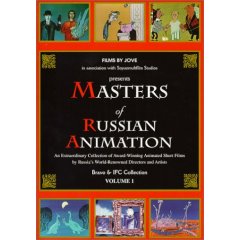
Masters of Russian Animation, Vol. 1

Various directors, 2000
Animated, Color, Subtitled, 133 minutes
All ages

Films included: The Story of One Crime (1962), The Man in the Frame (1966), My Green Crocodile (1966), There Lived Kozyavin (1966), Mountain of Dinosaurs (1967), Passion of Spies (1967), Glass Harmonica (1968), Ball of Wool (1968), Singing Teacher (1968), Film Film Film (1968).

A compendium of Russian shorts from the 60s produced in a variety of animation styles. Especially recommended: Vadim Kuchevsky's sweet, lyrical My Green Crocodile, done in stop motion; Nikolai Serebryakov's Ball of Wool about an old woman who knits herself a house from the wool of a magic sheep and is undone by her own greed, also stop-motion; and Anatoly Petrov's humorous Singing Teacher, done in pencil drawings, in which a hippopotamus tries warbling.

Friday, November 25, 2005

Sita Sings the Blues/The Sitayana

Artist Nina Paley
Sita Sings the Blues/The Sitayana; Viewable online

The Ramayana and the blues of the 20s (via vocalist Annette Hanshaw) get an exhilarating animation treatment from Nina Paley in this movie that's an accessible retelling of The Ramayana from Sita's perspective, and a fiery cross-cultural mash-up. Paley has been slowly building this work for years. When I first posted about it, Sita Sings the Blues was in progress and Paley was posting it to her website in chapter-sized chunks—now it's finished and collecting awards at festivals.

Here's a New York Times piece about it and how Paley developed the idea—a great story for people of any age about how creativity can be fueled by personal circumstance.

Despite Paley's difficulty in securing copyrights for some of the music in her animation, beginning February 26, 2009, Sita Sings the Blues will be viewable online through Channel 13, which is allowed to show it as a public broadcaster. This should be an active link to that.

For more of artist Nina Paley's work, including her graphic contributions to the Christmas Resistance Movement, visit
http://www.ninapaley.com/

Wednesday, August 17, 2005

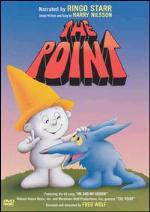
The Point

1971, Dir. Fred Wolf
74 min., color animation
Music by Harry Nilsson
Ages 5 and up

My generation saw it broadcast on TV; young ones now can rent it, and the message of accepting difference stays relevant. Most important, the music by Harry Nilsson will always be groovy. With voice performances by Ringo Starr as the father and Mike Lookinland (Bobby from The Brady Bunch) as the sweet wayfarer Oblio.

Tuesday, August 16, 2005

Love Is So Sweet


2004, Henry Lowengard and Nancy Graham—aka your host, red eft
Color digital animation
All ages

Here's one you can view online, in high- and low-bandwidth versions. My husband and I made it as an email Valentine; our daughter sings on the vocal track. Young children like to dance along with the animated characters with heart-shaped torsos; none are wearing any clothing, so consider this a naturalist cartoon.

Here's the link:

Love Is So Sweet

Sunday, May 15, 2005

The Fool of the World and the Flying Ship

1990 / Dir. Francis Vose
60 minutes, color animation

A Russian folktale told with charming stop-motion animation about a boy who wins the hand of a princess with help from friends with special talents. All ages.

The Films of Charles and Ray Eames

Five-Volume Set
Years various, genres various

Those who admire Charles and Ray Eames for their industrial design, art, or architecture but don't know their films should rush right out for this DVD collection. The jewel of the bunch is Powers of Ten, a 1977 short that starts with the aerial view of a man sleeping on a picnic blanket and travels out into the universe and back, then into the man's hand toward the reaches of the infinitely small, all by powers of ten.

The Eames team made dozens of films, and your kids will find their own favorites. Check out Blacktop, a meditation on the beauty of water splashing across asphalt, or Toccata for Toy Trains (both from vol. 2) or the antique spinning tops of Tops (vol. 5), scored by Elmer Bernstein.

All ages.

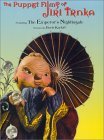
The Puppet Films of Jiri Trnka


1951, Dir. Milos Makovec , Jirí Trnka ,
156 min., color animation

Every child should be raised on honest-to-goodness, old-fashioned stop-motion animation, and Trnka, who died in 1969 at the age of 57, was an innovator whose films create rich settings for moving, delightfully playful stories. This DVD collection includes The Emperor's Nightingale (1951, 67 min.), based on Hans Christian Andersen's fairy tale and narrated by Boris Karloff. Short Subjects: Story of the Bass Cello (13 min.), The Song of the Prairie (21 min.), The Merry Circus (11 min.), A Drop Too Much (14 min.), The Hand (18 min.), Jiri Trnka: Puppet Animation Master (Documentary, 12 min.)

My children's favorite is The Hand, a political story of an artist whose studio is invaded by a giant hand that directs him to make a statue of it and abandon the clay pots he's been making for his plant. To an adult this piece has frightening resonance, and it does end with the artist's death, so your mileage may vary with respect to the kids' reaction. The Emperor's Nightingale is beautiful and effective. The Merry Circus uses stop-motion mixed with flat posable characters that cast shadows. My favorite, Story of the Bass Cello, has chiaroscuro lighting and a contemplative atmosphere. My only complaint about the bonus feature, a documentary about Jiri Trnka, is that it's much too short.

Potentially for all ages; but note that A Drop Too Much is about drinking and driving, and The Song of the Prairie, a hilarious send-up of westerns, involves gun play amid much Nelson Eddy-style singing.

Saturday, May 14, 2005

My Neighbor Totoro / Kiki's Delivery Service


My Neighbor Totoro
Japan / Dir Hayao Miyazaki
86 min, color animation


Kiki's Delivery Service
1989 / Dir Hayao Miyazaki
102 minutes, color animation

His movies are pure magic. Miyazaki may be too big to call 'alternative' at this point, but his films for younger children deserve inclusion here for their gentleness, their fascination with the unfolding details of daily life, their strong girls and tender boys, and the kinetic joy of flying viewers experience when characters go airborne.

Totoro is a magical forest being that comes into the life of two young girls when their mother is hospitalized. The family life at the core of the story gets a dose of whimsy from Totoro and other spirits of the forest, including a Cat Bus.

Kiki's Delivery Service is one of my daughter's favorite witch stories. A young girl coming of age as a witch and leaving home (at the age of thirteen!) befriends interesting women of all ages, who mentor her toward discovering what makes her special.

Recommended for ages 3 and older.

The Cosmic Eye / The Hubley Collection


1986 / Hubley Studio
70 min., color animation

Three musicians from outer space observe Earth and offer a message of peace to our planet. Pioneer animators Faith and John Hubley collaborated often, but this one is Faith Hubley's only feature-length animated work. Our family loves their animations; the drawings seem to flow from the unconscious right to the pen in this work.

Many of their shorts, such as Star Lore, Sky Dance and Cockaboody, and Moonbird have been assembled in The Hubley Collection, a must-see. Daughter Emily Hubley is also an animator with some work posted on her website.

Recommended for all ages.

Friday, May 13, 2005

The Adventures of Prince Achmed


1926, Dir Lotte Reiniger
65 minutes, black + white silhouette animation

I am so sorry it took me so long to see The Adventures of Prince Achmed by Lotte Reiniger. The exquisite silhouettes and the tints of the restored print now available on DVD captivated my family, my kids stayed up past their bedtime to see the whole thing. My daughter fell asleep during the little biopic about Reiniger that follows, but the rest of us were rapt at the story of this woman who single-handedly (literally—she did all the silhouette cutting) pioneered the animated film and invented the silhouette film, supported enthusiastically by her husband, Carl Koch and three other men who formed her production team. Their collaboration and their vibrant cultural life led to friendships with Jean Renoir and Bertolt Brecht. Racial stereotyping of the villains necessitates some discussion.

Recommended for all ages.

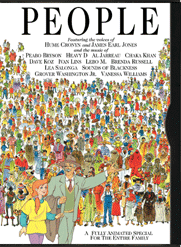
People


2003 / Prod. Joshua M. Greene
54 min., color animation

Based on a picture book by Peter Spier, here is the story of a girl and her grandfather on an imaginative journey exploring what makes people fight: is it difference? If we were all the exactly same, would we get along? Some of the animation here is stunning, especially a claymation sequence featuring eerie clone-people. Features the voices of Hume Cronyn and James Earl Jones, and music by Peabo Bryson, Al Jarreau, Vanessa Williams and Chaka Khan. Recommended by my 8-year-old for all ages.

Grocery Store Wars & The Meatrix


Here are two you can watch online! From FreeRange Studios come two Quicktime movies that satirize Hollywood movies and introduce organic farming, monocropping, pesticides and other "true costs" of food. Meet Obiwan Cannoli and Cuke Skywalker in Grocery Store Wars. (Vegetables shoot laser weapons and a melon explodes; some other violence.) See if you can escape The Meatrix! (Note: factory farming is at best disturbing. My motto: Before little eyes have seen, a loving guide should pre-screen!) These videos are being used by the Sierra Club in its new campaign to raise awareness of the politics of food.

The Meatrix Action Page: Ten things you can do to stop factory farms.

Kirikou and the Sorceress


France 2000 / Dir Michel Ocelot
74 mins. Color animation, dubbed into English
Original soundtrack by Youssou N'Dour

Kirikou climbs out of his mother's womb and begins to question the tyranny of a sorceress in his African village. A strong child hero, a female villain whose evil is born of pain, and a traditional setting in which characters are frankly and unembarrassedly naked are among the many pleasures of this animated film.

The sorceress can be creepy for children under six, so pre-screen it and use your discretion.