Sunday, August 24, 2014
Boyhood
Directed by Richard Linklater
Produced by Sandra Adair, Caroline Kaplan, Richard Linklater, Kirsten McMurray, Vincent Palmo Jr., Jonathan Sehring, John Sloss, Cathleen Sutherland, Anne Walker-McBay.
Color, live action, 164 minutes
Teens and up (see below)
I haven't posted here in a long time because living demands more attention than spectating, but I'm taking time out to plug a movie about, well, living: BOYHOOD. If you've read about it at all, you know that indie director Richard Linklater, whose films often deal with persistence and change through time, cast the lead, Ellar Coltrane, at the age of six. Everyone involved aged 12 years during the making of the movie.
Aside from that layer adding to what is already a moving chronicle of a family over the last decade, the shooting circumstances and lives of the makers that shadow the film add a level of richness to BOYHOOD that is less palpable, though obviously always present, in other films. Knowing the level of commitment of the ensemble of actors and crew, imagining their collaboration and the many ways the film likely parallels developments in their own lives, and sensing the sadness they must have felt when the shooting stopped, adds to the pondering of love and loss that runs through BOYHOOD. This is most explicit in a scene during which Patricia Arquette, who plays the central character's mother, lectures a psychology class on John Bowlby's attachment theory.
During a Q+A by producer John Sloss he mentioned that his kids—who are currently the sames ages as the characters Mason and Sam are at the start of BOYHOOD—have only seen that first section. So one way to watch this with kids would be segment by segment as they age. It's a movie to savor and revisit. For those watching it with teens now, while it's still fresh, it's quickly becoming a rite of passage.
Tuesday, December 13, 2011
Bullfrog Films for Activists
Here is a press release from Bullfrog Films about a great project; check it out:
Bullfrog Films Launches Groundbreaking Community Screenings Site
December 2011
Bullfrog Films, the nation’s leading distributor of films about environmental and related social justice issues, is excited to announce a groundbreaking initiative that brings documentary film to the heart of local and national activism.
Bullfrog Communities (http://www.bullfrogcommunities.com) empowers local organizers and activists by providing screening tools, an online publicity platform and licenses to organize free or for-profit screenings of award-winning new documentaries. Bullfrog Communities also enables organizers and viewers to participate in online campaigns relating to the documentary to further enact change.
"Film is uniquely capable of bringing an audience simultaneously up to speed on any given issue, and organizers can take advantage of that moment to open up an informed discussion of critical social issues in their community and, importantly, to take concerted action," said John Hoskyns-Abrahall, president of Bullfrog Films, founder of Bullfrog Communities.
One of the unusual features of Bullfrog Communities is that the screening license allows organizers to charge admission and to keep the proceeds from the screenings. So, in addition to the shared educational experience that only film can provide, a community screening can be an inexpensive, ready-made and attractive fundraiser for local groups.
Each film’s website provides a screening and discussion guide that details how to put on a successful screening; a list of suggested questions for the Q&A following the film; and a handout with links to resources and suggestions for further action.
The website features an expanding group of online communities built around different issues such as food, water, energy & climate change, civil liberties, and economic justice. Each issue area features a growing number of films plus a news feed and an ongoing discussion of the issue and of screenings nationwide. In this way the lessons learned from successful screenings in one community can be transferred to another.
Go to http://www.bullfrogcommunities.com to sign up and start the discussion going on the most pressing issue in your community! JOIN Bullfrog Communities to be alerted when new films are released for community screenings.
Wednesday, October 27, 2010
The 8½ Foundation
Tonight, while Googling Tilda Swinton, I discovered that in 2005—coincidentally the year I began Alternative Films for Kids—she co-founded The 8½ Foundation, a nonprofit whose "aim is to create a new birthday: a film birthday, at the age of 8½, that celebrates the power of cinema to expand children’s horizons and welcomes children into the wider world of movies, beyond what is normally available to them at the multiplex or on their TV screens."
They have a wonderful list of recommended films, many of which are here, many more of which are not (I'm slow, and busy, and don't spend as much time expanding this list as I'd like). Check it out.
Thursday, July 16, 2009
Stop Lookin', Listen
This blog focuses on visual media for children that I, in my infinite personal bias, would say falls outside the mainstream. Truth is, my kids spend more time listening to audio books (and reading), than watching, and I think that's a good thing. Limiting sensory input to one channel often deepens the waters.
This brings me to a plug for the short-story podcasts of The New Yorker. I've been listening to them during downtime lately, and this week I had to pull my kids into my bedroom to have a listen to Jonathan Franzen reading "Coyote v. Acme" by Ian Frazier. Frazier's parody of a legal brief, contrasting the formal, deflective language of legalese and the slapstick antics of the famous Warner Bros. cartoons is deft, hilarious, and affectionate. My children greatly enjoyed it.
Another good one for children (8+up, I'd say) is George Saunders reading "You Must Know Everything," by Isaac Babel. There's plenty to explore in the free podcast area of iTunes, from Selected Shorts and This American Life to more independent efforts—a free library for a rainy day or long car trip.
This brings me to a plug for the short-story podcasts of The New Yorker. I've been listening to them during downtime lately, and this week I had to pull my kids into my bedroom to have a listen to Jonathan Franzen reading "Coyote v. Acme" by Ian Frazier. Frazier's parody of a legal brief, contrasting the formal, deflective language of legalese and the slapstick antics of the famous Warner Bros. cartoons is deft, hilarious, and affectionate. My children greatly enjoyed it. Another good one for children (8+up, I'd say) is George Saunders reading "You Must Know Everything," by Isaac Babel. There's plenty to explore in the free podcast area of iTunes, from Selected Shorts and This American Life to more independent efforts—a free library for a rainy day or long car trip.
Labels:
all ages,
audio,
shorts,
view online
Tuesday, June 16, 2009
What's On Your Plate?
Directed by Catherine GundProduced by Tanya Selvaratnam
Co-produced by Sadie Rain Hope-Gund and Safiyah Kai Russell Riddle
With animation by Hubbub Inc.: Emily Hubley and Jeremiah Dickey
Color, documentary, 73 minutes
All ages
Upcoming screening:
BAM Cinemafest/Afro-Punk Opening Night Outdoor Screening
Saturday, June 27th, 6:00 pm
I show my kids a lot of documentaries—more than they want to see, frankly. So when I pulled What's On Your Plate? out of the envelope and said, "It's about food!" my son put on his blah face. "I've seen a ton of that stuff. I know." He's used to home cooking, CSAs, the backyard garden (even if a groundhog has kept it from coming up this year), he knows everything there is to know about healthy eating. But when the rest of the family popped it in and started watching, he came in and got hooked.
Co-produced and 'hosted' by two 7th-grade girls, Sadie and Safiyah, who live and eat in New York City, What's On Your Plate? welcomes a kids-eye view of food politics. School lunches, family farming, the mystery treat "Funyuns," and diet-related diseases are some of the topics, but the 'girl guides' leading the exploration, Sadie and Safiyah, bring humor and energy that keep the material from being dry or didactic, and so do their lively interview subjects—chefs, food activists, and farmers. Director Gund has no wish to feed us a lot of talking heads—she'd rather follow the girls as they amble through the city, visit the Angels, a Mexican farming family, or select cucumbers at their CSA. You get to watch people eat a lot. And Sadie and Safiyah don't shrink from asking the heads of food for NYC schools why Snapple is considered a suitable beverage to be serving kids from machines. "They don't have to drink it," one says.
I think one reason my kids found What's On Your Plate? interesting is that it talks about what happens when the food we see being grown around us—in Ulster County, two hours north of the city—reaches New York City. How do city residents get to know farmers? How does farm-fresh food get distributed to schools? How do people go about changing what's on their plate?
Labels:
activism,
all ages,
documentary,
eco,
girl power
Saturday, May 23, 2009
The Curious Adventures of Mr. Wonderbird

Available (and preferable) in French as Le Roi et l'Oiseau
Directed by Paul Grimault
Produced by André Sarrut
Color, animation, 63 minutes
Based on "The Sheperdess and the Chimney Sweep," by Hans Christian Andersen, adapted by Grimault and Jacques Prévert
Recommended for 8 and up
Astonishing for its inventiveness and surrealism, this odd and striking story may not be embraced by every child but is sure to give moments of delight. It goes by several titles and is available in both French and English; in this version, the title character, a despot-defying bird (who happens to be a doting single dad), is voiced hilariously by Peter Ustinov. A tyrant king, living in a castle high above his subjects, is in love with the portrait of a shepherdess, who comes to life from a painting. She and her true love, a chimney sweep, escape into a deserted city (picture Venice painted by de Chirico), and are then trapped in an underground kingdom where the king's subjects live without birds or sunlight. Full of surprises, amusements, and stunning animation. Apparently some have picked this gem up for a buck at WalMart, but greatly preferable: order the director's version, LE ROI ET L'OISEAU from Amazon.fr. The story easily survives a lack of subtitling, and kids deserve to see this level of cinematic art in the version intended by the creators. A few caveats: the king, who is both an object of fun and creepy, shoots bird for sport (though we don't see him kill one) and destroys his city with a giant waldo; there are moments of peril for major characters and the king dispenses with minor ones by pushing a button so they disappear through the floor or by having them flung aside by his robotic henchman. This is available in the English version on VHS from Facets for mail rental.
Thursday, May 21, 2009
Star Trek
The buzz was up about STAR TREK 2009. Good for kids, good story, very moving. My kids are now 12 and nearly 10, and maybe because they're a bit older now, tweens in fact, I talked them into going. My husband read me the review from Kids-in-Mind, but no red flags. Violence and gore got a 6 rating from them—compare to the 7 rating given PIRATES OF THE CARIBBEAN, which my kids saw over a year ago.
Besides, a younger friend of theirs had gone, and people were saying it's fine for kids.
Whoa, was I mistaken. Neither one of them liked the violence, the volume, the velocity—the three off-putting Vs of PG13dom. I don't know how Kids-in-Mind decided to rate the violence at 6. How could a man bound to a table to be tortured, a large insect forced down his throat, rate a 6? What kind of torture gets a 10? It feels like the world is getting less sensitive, but I'm becoming more grateful for my children's sensitivity.
My son is a particular fan of the MPAA ratings system—he even has it tacked to his bedroom wall. Because of him I've adjusted my attitude toward ratings. When I was single and living in New York, I once interviewed the director Abel Ferrara and recall his outrage that his teenage son might be prohibited from seeing whatever movie he liked. From his point-of-view it was a self-expression issue, and I agreed.
For my son, it's a self-protection issue. He values the ratings system because he's not ready for sexual themes, he doesn't like seeing cruelty, especially if it's aimed at animals, and Hollywood movies tend to overwhelm him with their explosions, constant orchestral climaxing, and endless chase sequences. He's the one sitting through the previews with his fingers in his ears.
Another reason my kids didn't go in for STAR TREK is that they lack the allegiance, formed over decades, to the series that my husband and I have. While we are not Trekkers, I for one spent a good deal of my youth with the crew of the Enterprise. Naturally I paid close attention to the women, the few there were: Nurse Christine Chapel, Yeoman Janice Rand, and the biggie: Lt. Uhura.
Uhura and the actor who played her, Nichelle Nichols, carry a lot of cultural heft. Nichols was one of the first Black women on a TV series not to play a domestic worker (Diahann Carol in the 1968 Julia was another trailblazer I watched without quite understanding, but maybe intuiting, the import—I was seven that year). An episode in which she kissed William Shatner broke a barrier. After the first season, she thought of quitting, but Martin Luther King, Jr. persuaded her to stay on, citing the impact she was having.
Her character never rose to the prominence many viewers would have liked, and struggled in relative obscurity even when STAR TREK crossed into feature film territory.
But it still shocked me, though maybe it shouldn't have, to see how little the capable Zoe Saldana has to work with in the new STAR TREK. While her brethren are given
emotionally rich origin stories to add depth to their relationships, she is left with a gag about her first name and a running sex joke about her professional field of linguistics. It's implied that she wants to serve on the Enterprise in order to be near her boyfriend, Spock. Gone is the dignity of the TV version of Uhura, who once came upon a shipmate and began speaking Swahili with him (too bad he turned out to be a monster in disguise). I will never forget sitting in my suburban living room listening to Swahili and thinking it the most beautiful language I'd ever heard.
Besides, a younger friend of theirs had gone, and people were saying it's fine for kids.
Whoa, was I mistaken. Neither one of them liked the violence, the volume, the velocity—the three off-putting Vs of PG13dom. I don't know how Kids-in-Mind decided to rate the violence at 6. How could a man bound to a table to be tortured, a large insect forced down his throat, rate a 6? What kind of torture gets a 10? It feels like the world is getting less sensitive, but I'm becoming more grateful for my children's sensitivity.
My son is a particular fan of the MPAA ratings system—he even has it tacked to his bedroom wall. Because of him I've adjusted my attitude toward ratings. When I was single and living in New York, I once interviewed the director Abel Ferrara and recall his outrage that his teenage son might be prohibited from seeing whatever movie he liked. From his point-of-view it was a self-expression issue, and I agreed.
For my son, it's a self-protection issue. He values the ratings system because he's not ready for sexual themes, he doesn't like seeing cruelty, especially if it's aimed at animals, and Hollywood movies tend to overwhelm him with their explosions, constant orchestral climaxing, and endless chase sequences. He's the one sitting through the previews with his fingers in his ears.
Another reason my kids didn't go in for STAR TREK is that they lack the allegiance, formed over decades, to the series that my husband and I have. While we are not Trekkers, I for one spent a good deal of my youth with the crew of the Enterprise. Naturally I paid close attention to the women, the few there were: Nurse Christine Chapel, Yeoman Janice Rand, and the biggie: Lt. Uhura.
Uhura and the actor who played her, Nichelle Nichols, carry a lot of cultural heft. Nichols was one of the first Black women on a TV series not to play a domestic worker (Diahann Carol in the 1968 Julia was another trailblazer I watched without quite understanding, but maybe intuiting, the import—I was seven that year). An episode in which she kissed William Shatner broke a barrier. After the first season, she thought of quitting, but Martin Luther King, Jr. persuaded her to stay on, citing the impact she was having.Her character never rose to the prominence many viewers would have liked, and struggled in relative obscurity even when STAR TREK crossed into feature film territory.
But it still shocked me, though maybe it shouldn't have, to see how little the capable Zoe Saldana has to work with in the new STAR TREK. While her brethren are given
emotionally rich origin stories to add depth to their relationships, she is left with a gag about her first name and a running sex joke about her professional field of linguistics. It's implied that she wants to serve on the Enterprise in order to be near her boyfriend, Spock. Gone is the dignity of the TV version of Uhura, who once came upon a shipmate and began speaking Swahili with him (too bad he turned out to be a monster in disguise). I will never forget sitting in my suburban living room listening to Swahili and thinking it the most beautiful language I'd ever heard.
Labels:
African-American history,
feature,
girl power,
hollywood
Friday, April 10, 2009
FLOW: For Love of Water
2008, color documentary, 93 minutesDirected by Irena Salina
Produced by Steven Starr
8 and up
Salina's documentary views the global water crisis through the eyes of activists struggling for access to clean, free water. The stories told here are fairly easy to follow for 8 and up, and kids used to seeing plastic bottles of 'blue gold' for sale everywhere really ought to hear this side of things. Activist/thinkers Vandana Shiva and Maude Barlow figure prominently in this narrative of an essential question of our time: can nature—the very elements of life—be owned? Or are they aspects of the worldwide commons, our birthright, what we share and steward together?
In the Hudson Valley, this film is making the rounds as a fundraiser for water-related issues such as those raised in Rosendale,NY by Save the Lakes.
Labels:
activism,
documentary,
eco,
girl power,
poverty,
science
Thursday, January 15, 2009
Preview + Review of Long-Awaited CORALINE
CORALINE is scheduled for release to theaters on February 6, 2009.
My son Ray has been making movies since he was six: stop motion animation, live action, and lately, CGI parodies of Star Wars. He reads film production books and bios of animators like Chuck Jones, and loves ‘making-of’ bonus features and little biopics about revered figures like Ray Harryhausen. One of his ‘mentors’ is Henry Selick, who has just completed his adaptation (for 3D stop-motion animation) of Neil Gaiman’s novel, Coraline.
It was our enormous good fortune—mine, my son’s, my daughter’s, my husband’s, and his mother’s—to visit the set of Coraline a couple of years ago, and a real treat to see a preview screening of the finished work the other night in Manhattan, with Henry Selick on hand to answer audience questions.
My son wasn't sure he wanted to see a "horror" movie.
So we headed into NYC with the plan that he would shut his eyes, pull his jacket up over his face, and hold his hands to his ears if it all got to be too much. He was willing to endure, if only for the Q&A portion of the evening.
As it turns out, he didn’t have to worry too much. He only shut his eyes once, and not for long. While the idea of Coraline is truly terrifying—a girl is left alone to rescue her supernaturally abducted parents—its creators have allowed the idea to carry most of the weight of emotion, as with the best fairy tales, and haven’t piled onto it with 3D shock effects or long, anxiety-provoking suspense sequences. The Nightmare Before Christmas, with its cast of characters in varying states of decomposition, is more horrific—at least to me, and I think my son, who got to an age where he felt too uneasy to watch it, and wouldn’t go near the undead-dominated Corpse Bride, would agree.
Henry Selick has done a beautiful job of reconceptualizing the novel for the screen and for stop motion. From the first moments, when metal hands sew up a doll-sized version of the title character and cast her into a void, it feels like this is a movie partly about the animator and the animator’s art. These are the hands of the evil Other Mother, creator and destroyer of the Other World, but here they are, bare of fleshly trappings, primordial armature. We come to find that the energy of children is what makes the Other Mother’s material other world, and it is their life force that makes it beautiful, whimsical, and inviting.
If you have watched any of the featurettes about Coraline, you have seen artist after artist toiling and tinkering away, as artists always do on these projects, though now, with the Internet, in less obscurity. They can even blog about their work for Laika Studios. It’s hard to watch that image of armature hands making the Coraline doll and not think of all the human hands that have gone into the making of this supremely hand-made movie, and seeing in these moments a tribute to them all (certainly they deserve a tribute, including those several dozen Laika workers, I was sorry to read, who were recently laid off).
OtherMotherWorld is especially fanciful and so packed with detail it's hard to imagine not seeing the movie many times to try to take it all in. Henry S. has ensured that the Other Mother’s overture to Coraline is suitably seductive. She—and we—are truly tempted to stay and sample more delights from the animators’ cabinet of wonders. (And the wonders really are wonderful; we laughed throughout the early other world scenes.)
Henry Selick’s Other Mother is a kind of ‘50s fantasy mom—she cooks brilliantly in heels, perfect make-up, and manicure and wears a stainless, starched apron. Other Father is affable, doting, and fun (aside from the saucy, riotous French and Saunders as the Misses Spink and Forcible, my favorite vocal performance is John Hodgman's as the Fathers Real and Other).
Coraline's real world parents, by contrast, are familiar to us as contemporary, overworked telecommuters (fortunate in that sense, they write at home on gardening) who share the work of their life equally, don’t exactly excel in the kitchen, and don’t have much time for their daughter.
That Coraline's creativity will rival the Other Mother's is intimated by a lovely scene that is not in Neil Gaiman’s book. Having returned from an early foray into the other world, Coraline finds her apartment empty; her parents have not come home from work and grocery shopping. Newly arrived in a strange place, friendless and now abandoned by her parents, she goes to bed alone, making pillow-people versions of her mom and dad to comfort herself—the Other Mother isn't the only one who can conjure power from a doll. I think Coraline's realization that they're not coming back is the scariest moment in the story (though Gaiman's protagonist is pretty brave at this point, as I recall). Henry S. wisely lingers long enough for us to feel her loneliness and her sadness.
A resourceful adventurer who is, like too few movie protagonists—even at the dawn of the 21st century—a girl, Coraline would be perfect if not for Henry S.’s addition of a boy to come to her aid in her time of need. Or so I thought when I heard about him. But Wybie (nicknamed "Why Be Born" by Coraline—I guess Henry S. knew some of us would resist), who gives Coraline someone other than a (really cool) cat to dialog with, adds a melancholy element to the other world, where he is more expressive for his muteness.
When my son and I came back up the Hudson River the day after the screening, and made our report to his sister, she said, “I think I’ve changed my mind. I do want to see Coraline.” I look forward to seeing it again with her.
We were too shy to ask for a shot of Henry S. with Ray, but here he is after the Q&A. Be sure to view through your 3D glasses.
I'll be blogging more thoughts on Coraline on my other blog, Oswegatchie. Look for the Coraline tag.
My son Ray has been making movies since he was six: stop motion animation, live action, and lately, CGI parodies of Star Wars. He reads film production books and bios of animators like Chuck Jones, and loves ‘making-of’ bonus features and little biopics about revered figures like Ray Harryhausen. One of his ‘mentors’ is Henry Selick, who has just completed his adaptation (for 3D stop-motion animation) of Neil Gaiman’s novel, Coraline. It was our enormous good fortune—mine, my son’s, my daughter’s, my husband’s, and his mother’s—to visit the set of Coraline a couple of years ago, and a real treat to see a preview screening of the finished work the other night in Manhattan, with Henry Selick on hand to answer audience questions.
My son wasn't sure he wanted to see a "horror" movie.
So we headed into NYC with the plan that he would shut his eyes, pull his jacket up over his face, and hold his hands to his ears if it all got to be too much. He was willing to endure, if only for the Q&A portion of the evening.
As it turns out, he didn’t have to worry too much. He only shut his eyes once, and not for long. While the idea of Coraline is truly terrifying—a girl is left alone to rescue her supernaturally abducted parents—its creators have allowed the idea to carry most of the weight of emotion, as with the best fairy tales, and haven’t piled onto it with 3D shock effects or long, anxiety-provoking suspense sequences. The Nightmare Before Christmas, with its cast of characters in varying states of decomposition, is more horrific—at least to me, and I think my son, who got to an age where he felt too uneasy to watch it, and wouldn’t go near the undead-dominated Corpse Bride, would agree.
Henry Selick has done a beautiful job of reconceptualizing the novel for the screen and for stop motion. From the first moments, when metal hands sew up a doll-sized version of the title character and cast her into a void, it feels like this is a movie partly about the animator and the animator’s art. These are the hands of the evil Other Mother, creator and destroyer of the Other World, but here they are, bare of fleshly trappings, primordial armature. We come to find that the energy of children is what makes the Other Mother’s material other world, and it is their life force that makes it beautiful, whimsical, and inviting.
If you have watched any of the featurettes about Coraline, you have seen artist after artist toiling and tinkering away, as artists always do on these projects, though now, with the Internet, in less obscurity. They can even blog about their work for Laika Studios. It’s hard to watch that image of armature hands making the Coraline doll and not think of all the human hands that have gone into the making of this supremely hand-made movie, and seeing in these moments a tribute to them all (certainly they deserve a tribute, including those several dozen Laika workers, I was sorry to read, who were recently laid off).
OtherMotherWorld is especially fanciful and so packed with detail it's hard to imagine not seeing the movie many times to try to take it all in. Henry S. has ensured that the Other Mother’s overture to Coraline is suitably seductive. She—and we—are truly tempted to stay and sample more delights from the animators’ cabinet of wonders. (And the wonders really are wonderful; we laughed throughout the early other world scenes.)
Henry Selick’s Other Mother is a kind of ‘50s fantasy mom—she cooks brilliantly in heels, perfect make-up, and manicure and wears a stainless, starched apron. Other Father is affable, doting, and fun (aside from the saucy, riotous French and Saunders as the Misses Spink and Forcible, my favorite vocal performance is John Hodgman's as the Fathers Real and Other).
Coraline's real world parents, by contrast, are familiar to us as contemporary, overworked telecommuters (fortunate in that sense, they write at home on gardening) who share the work of their life equally, don’t exactly excel in the kitchen, and don’t have much time for their daughter.
That Coraline's creativity will rival the Other Mother's is intimated by a lovely scene that is not in Neil Gaiman’s book. Having returned from an early foray into the other world, Coraline finds her apartment empty; her parents have not come home from work and grocery shopping. Newly arrived in a strange place, friendless and now abandoned by her parents, she goes to bed alone, making pillow-people versions of her mom and dad to comfort herself—the Other Mother isn't the only one who can conjure power from a doll. I think Coraline's realization that they're not coming back is the scariest moment in the story (though Gaiman's protagonist is pretty brave at this point, as I recall). Henry S. wisely lingers long enough for us to feel her loneliness and her sadness.
A resourceful adventurer who is, like too few movie protagonists—even at the dawn of the 21st century—a girl, Coraline would be perfect if not for Henry S.’s addition of a boy to come to her aid in her time of need. Or so I thought when I heard about him. But Wybie (nicknamed "Why Be Born" by Coraline—I guess Henry S. knew some of us would resist), who gives Coraline someone other than a (really cool) cat to dialog with, adds a melancholy element to the other world, where he is more expressive for his muteness.
When my son and I came back up the Hudson River the day after the screening, and made our report to his sister, she said, “I think I’ve changed my mind. I do want to see Coraline.” I look forward to seeing it again with her.
I'll be blogging more thoughts on Coraline on my other blog, Oswegatchie. Look for the Coraline tag.
Labels:
animation,
feature,
girl power,
hollywood,
puppets
Tuesday, August 26, 2008
Children of Heaven (Bacheha-Ye aseman)
1997, color feature, 88 minutesDirected and written by Majid Majidi
Producer, Amir Esfandiari, Mohammad Esfandiari
In Persian with subtitles
All ages
This Iranian film centers on a brother and sister forced to share a pair of sneakers when the boy Ali (played beautifully by Amir Farrokh Hashemian) loses his sister Zahra's newly-repaired shoes. A meditation on Iranian daily life (including scenes at a mosque), scarcity vs. plenty, and family bonds, Children of Heaven is also a suspenseful yarn. Its PG rating, as near as I can figure, has to do with Ali's father yelling "shit!" when his bicycle breaks stop working and he and his son are about to crash. Also, he is verbally harsh with his family, particularly at the beginning, but it quickly becomes clear that he is honest and loving, if overworked. Engaging, stunning to look at, a glimpse at Iranian culture that has a realistic feel. I'm giving this the "girl power" label because Ali's sister Zahra, played by Bahare Seddiqi, washes the dishes, tends the baby, cleans the house, and gets her homework done—one could imagine such a girl growing up to be a world leader.
Thursday, June 26, 2008
Chisholm '72: Unbought and Unbossed

Shola Lynch, 2004
76 minutes, documentary
Best for ages 5+
I was 11 in 1972 when Congresswoman Shirley Chisholm became the first woman and first black person to run as successfully as she did for president of the United States, and my son is 11 now. Watching this documentary with him and my 9-year-old daughter really put this year's campaign in perspective. The footage here demonstrates some of the long road that has led to Barack Obama's candidacy, reveals by contrast the shallowness of the media analysis of race and gender in the current campaign, and offers a refreshing, even bracing introduction to a candidate who was not afraid to speak out and take strong, clear, progressive positions. "I want to be remembered as a woman who dared to be a catalyst for change," said Chisholm. A great introduction to a figure your children should know about (even if they don't understand all of it), a primer in issues that come up in every campaign, and some good context related to the movements for the rights of women and African-Americans.
Friday, May 16, 2008
Cyrano de Bergerac
Jean-Paul Rappeneau, 1990137 minutes, color feature, subtitles
Ages 8 & up (battle scene at end with explosions and some blood)
With musketeers, witty word play, a confederacy of poets, and a story about who and why we love, the story of Cyrano de Bergerac is great for kids. This production features a spirited, soulful performance by Gerard Depardieu. Another great actor, José Ferrer, made a version in 1950 and there are numerous other versions. My 8-year-old had a little trouble keeping up with the subtitles, but there is plenty of action to keep a non-reading viewer interested, and those who don't follow the subtitles can still listen to the music of the rhyming couplets in French. Girl power alert: Roxanne, love object to two men, has little to do but in Act IV does dress up as a man during a fight with Spanish soldiers and sneak food to the French cadets.
Tuesday, May 13, 2008
Note by Note: The Making of Steinway L1037
Ben Niles, 200781 minutes, color documentary shot on tape
All ages
Anyone old enough to sit through a documentary, and that could be anybody, should be rapt at this account of the process and people behind a Steinway grand piano, from the multinational craftspeople who painstakingly ply their trade in a Queens factory, passing their art down from one generation to the other through hands-on training, to the musicians who appreciate in their own way the personality differences between one piano and another. "It was nice to see the Steinway being made—spray-painted and having its strings straightened," said a 10-year-old viewer.
Tuesday, May 22, 2007
Word Play
Patrick Creadon, 2006 94 minutes, color documentary
7 and up, rated PG for mild reasons detailed in the review of this movie at Kids-in-Mind
Using NPR puzzlemaster and New York Times puzzle editor Will Shortz as a focal personality, this documentary is all about crosswords, those who make them and those who complete them—in well under five minutes, every week and at an annual competition held in Connecticut since 1975. Kids should enjoy the story of how Shortz, at a young age, determined to spend his life with puzzles and created his own college major—enigmatology—to prepare himself for his chosen vocation. Others will be amused by the longstanding rule of etiquette that prevents anything remotely scatological from being used in a crossword, a state of affairs that vexes puzzle constructors in need of vowel-rich words like "enema". The DVD comes with lots of bonus features for extra fun that should inspire a run on crossword books at your house.
Wednesday, April 18, 2007
Women. We'll Settle for Half.
That's the official t-shirt of an organization called See Jane, founded by Geena Davis to correct the remarkable continuing disparity between male and female characters in programming aimed at young people. Incredibly, the entertainment industry needs more studies and data to convince it that girls, and female smurf-like characters and animals and so forth, are still largely missing from the sewage system that is mass media. Such activities keep the Annenberg School in business, I suppose, but sheesh, we all know TV and movies are male-dominated stories told from male perspectives with a pink bow slapped on here and there, and rather frequently a dead mother, to make us shed a tear. What a crushing bore! If it weren't for the exceptions, many of them celebrated right here at Alternative Films for Kids, we'd give up. But the exceptions shine so gloriously that we, like the good people at See Jane, prefer to keep pushing for improvement. Davis spoke about See Jane recently at the National Conference for Media Reform. (After watching Geena, have a look at the amazing keynote by Bill Moyers).More good news for girls: Henry Selick is now in production with an animated screen adaptation of Neil Gaiman's Coraline. This is a story about a girl. That's it! No boy sidekick, no brother, and very few male characters to distract from the strength, determination and loving maturity of the girl who travels to the dark side on a rescue mission and finds her way back again—without a Frodo, a Skywalker, a Buzz Lightyear or a Sully to help her.
Labels:
activism,
animation,
girl power,
hollywood
Tuesday, April 10, 2007
Musik und Zaubereien & Märchen und Fabeln
250 minutes, released 2007
150 minutes, rel. 2006Lotte Reiniger
Black & white shorts compiled on DVDs
All ages
If you've seen The Adventures of Prince Achmed (scroll down, it's there somewhere), you and your children will no doubt be delighted that more of the work of Lotte Reiniger, the brilliant German animator who lived from 1899 to 1981, is available on DVD. The delicate silhouettes, in black & white, tinted, and in color (though they're best with the more muted backgrounds), enchant in these versions of popular fairy tales such as "The Golden Goose," "Cinderella" (note for younger viewers: the sister slices off her heel and makes a bloody mess!) and "Jack in the Beanstalk." Musik und Zaubereien gives us a Magic Flute with the best bits of Papageno—as he sings, women turn to birds and fly away, eggs hatch to reveal Papageno & Papagena's babies. "Carmen" has a happy ending and a feminist spirit that infuses many of Reiniger's short films. Hours of stunning animation here, mostly suitable for all ages. These may be hard to rent but can be ordered from Amazon.de—I was surprised to find that my U.S. account and password transferred without a hitch.
Monday, April 09, 2007
The Way Things Go
Peter Fischli & David Weiss, 1987color, 30 minutes
All ages
"Everyday objects doing cool things," is how my daughter described this chain of events set off by a spinning garbage bag. Foam, fire, explosions, liquids and wheels, a bit of physics and chemistry, and you have thirty minutes of ooh-ing and ah-ing. Delightfully, this film is ultimately about story, and children will love being the narrator, but they should spend at least one viewing listening. The Honda ad, "Cog," that purloined the concept and ideas from this film inspires awe too, but the original is more fun—longer, messier, and the objects have more personality.
Highly recommended for all ages.
Thursday, March 15, 2007
Alternative Videos of Woodstock CLOSED
Their name was already outdated, as they were replacing tapes with DVDs. So is our other local store, Alice in Videoland. "Alternative DVDs of Woodstock" and "Alice in DVDland" sure don't sound too poetic, but they wouldn't have lasted long anyway.
Members filed into the store at noon to pick over the stock. Hard choices. My son and I wound up with a bag full—a Scooby Doo tape, Cirque de Soleil and an episode of Ghost Writer (scored by a family friend) for him. For me and the rest of the family:
Documentaries: The Wobblies, Sister Helen (I thought it was about Helen Prejean; it's not; I hope it's good), Kilowatt Ours, In the Mirror of Maya Deren, Yours for a Song: The Women of Tin Pan Alley; Cinema Verite: Defining the Moment
Animation: Hiroshima No Pika; The Adventures of Prince Achmed (scroll down for the altfilmskids review)
Features: I Know Where I'm Going, Alexander Nevsky, Last Year at Marienbad
Compilations: America's First Women Filmmakers; Treasures from the American Film Archives
Performance: Great Pas de Deux for the ballet dancer in the family.
I didn't take the best stuff there but what I did get took two hours of standing in line at lunch hour and it was hard to choose.
I ran into four friends there and chatted with strangers. The woman next to me on line and I praised Tilda Swinton's performance in Deep End and discussed other films about motherhood. Another woman held up Black Stallion and said the opening was one of her favorite films, with which I heartily concur. Another woman bought every episode of The L Word. It was like a funeral—nice to be with people but for such a sad occasion, with all our favorite store employees pacing the aisles behind the counter to match empty boxes with tapes and discs. This is one of those stores where the staff is learned, like librarians, not like the vapid crew at Blockbuster, where you go in and ask for Meet Me in St. Louis and the kid has never heard of Vincent Minelli. This is a real loss to the community, and you probably have a similar story in progress in your town.
I wish everyone at Alternative Video a future of luminous endeavors.
Thursday, February 01, 2007
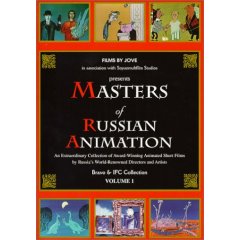
Masters of Russian Animation, Vol. 1
Various directors, 2000Animated, Color, Subtitled, 133 minutes
All ages
Films included: The Story of One Crime (1962), The Man in the Frame (1966), My Green Crocodile (1966), There Lived Kozyavin (1966), Mountain of Dinosaurs (1967), Passion of Spies (1967), Glass Harmonica (1968), Ball of Wool (1968), Singing Teacher (1968), Film Film Film (1968).
A compendium of Russian shorts from the 60s produced in a variety of animation styles. Especially recommended: Vadim Kuchevsky's sweet, lyrical My Green Crocodile, done in stop motion; Nikolai Serebryakov's Ball of Wool about an old woman who knits herself a house from the wool of a magic sheep and is undone by her own greed, also stop-motion; and Anatoly Petrov's humorous Singing Teacher, done in pencil drawings, in which a hippopotamus tries warbling.
Tuesday, December 12, 2006
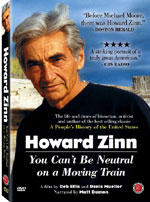
You Can't Be Neutral on a Moving Train
Deb Ellis and Dennis Mueller, 2004color and b+w documentary, 78 minutes
Ages 9? & up
Resident 9-year-old says, "Well, I enjoyed it, but I think most kids would be restless and would rather watch a horrible crappy movie called The Wild instead of this." (Um, we didn't see The Wild.)
It ain't for nothing that you're parked at Alternative Films for Kids, folks!
This profile of professor/activist Howard Zinn, author of The People's History of the United States (which has sold a million copies), covers his adult life, which has spanned many of the key social and peace movements of our time. Ellis and Mueller track Zinn from his labor activism to his experience in the air force to his days as a Civil Rights leader at Spelman College to his peace activism during the Vietman War—and beyond. This is a great way for kids too young to read A People's History to learn some people's history—through the life of an engaged historian who continues to work for social justice.
Definitely not The Wild.
Note: contains some graphic archival footage of American police brutalizing demonstrators, bombs dropping during WWII and Vietnam, and Vietnamese civilians under attack.
Labels:
activism,
American history,
documentary
Subscribe to:
Posts (Atom)